

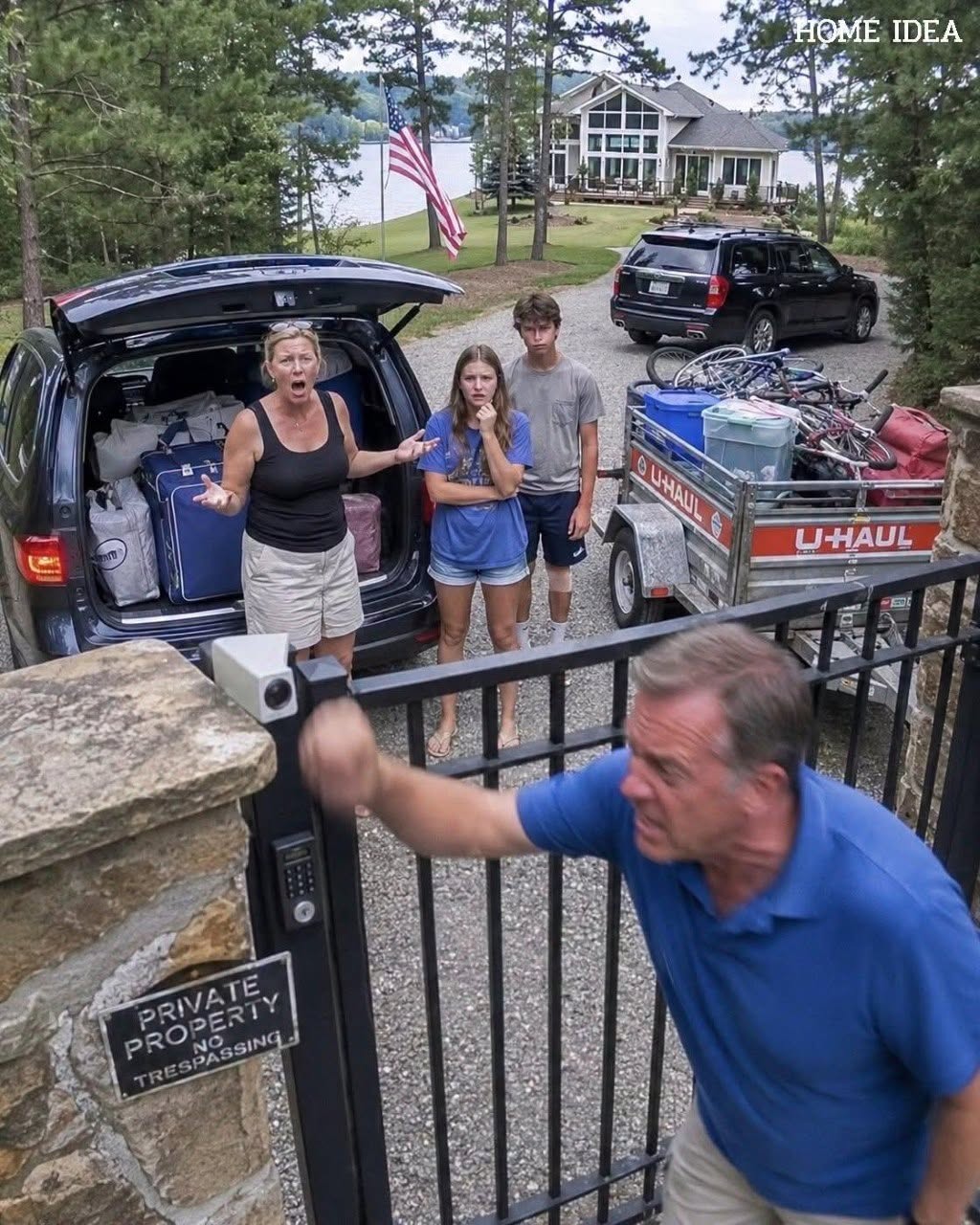
By the time my father stood outside my lake house gate with his finger jammed against the keypad, I already knew the story my family would tell about me.
They would say I was cold.
They would say I had changed.
They would say money had gone to my head, because that was easier than admitting they had spent years treating my life like a spare room.
The truth started at 7:12 on a Thursday morning
I was standing barefoot in my kitchen in Charlotte, holding coffee that smelled dark and sharp and tasted like nothing because my father’s text had just appeared on my phone.
Your vacation house is perfect for the family reunion. We’re coming next month.
That was it.
No question.
No apology for assuming.
No hint that the house belonged to the person who had signed the closing documents, made the down payment, paid the taxes, paid the insurance, paid Wade to keep the dock from rotting, and paid the security company to keep the gate working.
Before I could answer, my mother called.
She sounded cheerful, which in my family usually meant she had already made a decision for me and was now going to manage my reaction.
‘And Melissa’s boys are probably staying most of the summer,’ she said. ‘You hardly use the place anyway.’
I remember the cold tile under my feet.
I remember the refrigerator humming.
I remember staring at my own hand around the mug and thinking that I had spent twelve years becoming the kind of woman who could buy one quiet place for herself, and my family had needed less than nine months to turn that place into group property in their heads.
The house sat on Lake Norman, forty minutes north of the city.
It had a coded gate, a private dock, a screened porch, three bedrooms, and a little room off the kitchen where I kept extra towels, paper plates, and the cheap coffee I actually liked.
At night, the lake was quiet enough that I could hear water tapping softly against the pilings.
That sound was the reason I bought it.
Not the dock.
Not the view.
The stillness.
I had bought the house for $680,000 after years of sales conferences, airport delays, hard conversations with hospital purchasing teams, and quotas that did not care whether I was tired.
People in my family liked to joke that I was intense.
Uptight.
Too serious.
They never joked when they needed money.
They never joked when Melissa needed my car after her transmission failed and kept it for more than a month.
They never joked when my parents visited Charlotte and decided my first apartment after college was cheaper than a hotel.
They never joked when my mother stored half her craft supplies in my guest room because, as she told me, I lived alone and had room.
That was how it worked.
My things were mine until someone else wanted them.
Then suddenly they became a family resource.
A good daughter shared.
A good sister understood.
A reasonable woman did not make everyone feel awkward by saying no.
So when my mother told me Melissa’s boys might stay most of the summer, I heard more than a request.
I heard the whole plan.
I heard coolers on my porch, wet towels on the floor, cousins with air mattresses, Uncle Ron’s boat tied to my dock, kids leaving toys in the yard, my parents sleeping in the room I had chosen for myself, and everyone acting confused when I finally snapped.
I should have stopped it then.
Instead, I said, ‘Sure.’
My mother went quiet.
It was only a second, but I knew that silence.
She had expected resistance.
She had rehearsed the speech about family and selfishness.
She had probably been ready to tell me that Melissa had it hard, that Dad was getting older, that I did not understand what it meant to have children, that a house sitting empty was wasteful.
When I did not give her the fight she wanted, she called to my father in the background.
‘See? I told you she’d be reasonable.’
Reasonable.
That word stayed with me all day.
By noon, Melissa had texted about bedding.
By dinner, my father had mentioned Uncle Ron towing his fishing boat.
By the next week, my mother was talking about cousins bringing air mattresses.
By week three, the reunion had stretched from a weekend to ten days to maybe two weeks to possibly most of the summer if it was easier for the boys.
Easier for them.
Nobody asked what was easier for me.
On a Saturday morning, I drove to the lake house and met Wade by the gate.
Wade was a retired contractor with weathered hands, a practical truck, and the kind of calm that made him useful in a crisis because he never tried to make one bigger.
He handled landscaping, dock repairs, small maintenance, and the things I did not have time to inspect between work trips.
He knew my family had been using the old gate code because I had told him once, months earlier, when my parents stopped by without warning and acted wounded that the house was locked.
I told him I needed everything reset.
He did not ask dramatic questions.
He just nodded and walked the property with me.
By Sunday evening, the exterior locks had been changed.
The smart entry system had been wiped.
The garage remotes were deactivated.
The gate keypad had a new code.
The Wi-Fi admin access was reset.
The security company updated the camera zones and added an alert for multiple failed entries at the gate.
I saved the work order.
I saved the new access log.
I saved a copy of the deed and closing disclosure in the same folder on my phone, not because I thought my parents had a legal claim, but because family arguments have a way of turning into emotional fog.
Facts cut through fog.
I did not call my mother.
I did not warn Melissa.
I did not tell my father that the old code was gone.
Silence had always been the tool they used against me.
For once, I let it work in my direction.
The first Friday in June was bright and hot.
Charlotte traffic had already started to thicken outside my office window, and my desk smelled faintly like printer toner and the paper coffee cup I had forgotten to throw away.
I was halfway through quarterly reports when my phone lit up.
Motion alert.
Front gate camera.
I opened it.
For a second, I just stared.
My father’s SUV was at the keypad.
Melissa’s minivan was behind him.
Behind that was a rented U-Haul trailer loaded with plastic storage bins, bicycles, folding chairs, coolers, duffel bags, beach towels, and enough luggage to make the truth plain.
This was not a family reunion.
This was a move-in attempt with snacks.
My father got out first.
He walked to the keypad with the confidence of a man who had never seriously considered that the gate might not open for him.
He punched in the old code.
The gate stayed closed.
He tried again.
The camera caught him frowning.
Melissa got out of the minivan and opened the side door, already talking to the boys like the delay was a small inconvenience.
My mother stepped onto the gravel in oversized sunglasses and looked around the entrance like she was inspecting a property she planned to rearrange by dinner.
My phone started ringing.
Dad.
Mom.
Melissa.
I let every call go to voicemail.
On the camera, my father jabbed the code a third time.
Then a fourth.
The alert counter climbed.
I sat in my office chair and watched him step back from the keypad.
He stared up at the camera.
‘Open it,’ he shouted.
His voice came through the feed rough and angry, but beneath the anger I heard something else.
Shock.
Not at being locked out of a house he did not own.
Shock that I had dared to behave like the owner.
I muted my office phone.
I opened the live intercom.
My mother tilted her face up when the tiny speaker clicked.
I watched her understand, in real time, that I had seen the SUV, the minivan, the trailer, the bins, the coolers, the whole plan they had built around my silence.
Then I said, ‘No.’
For a moment, the gate area froze.
My father’s hand stayed near the keypad.
Melissa stopped tugging a bag from the van.
My mother’s mouth opened slightly, then closed.
‘What do you mean, no?’ my father demanded.
‘I mean you are not staying at my house.’
He gave a short laugh, but there was no humor in it.
‘Don’t start this. We drove all this way.’
‘You drove all this way without being invited.’
Melissa came closer, her voice high enough that the camera microphone clipped a little.
‘The boys are tired. Mom said it was handled.’
‘Mom does not own my house,’ I said.
That sentence hit harder than I expected.
Not because it was complicated.
Because it was the first time I had said it plainly.
My mother stepped toward the intercom.
‘Honey, you told me sure.’
‘I told you sure when you said family reunion,’ I said. ‘You arrived with a U-Haul.’
My father looked back at the trailer as if he had forgotten it was visible.
That was when my mother reached into her tote and pulled out a folded paper.
She did it automatically, the way organized people reach for proof when they believe proof is on their side.
Even through the camera, I saw the columns.
Names.
Dates.
Rooms.
A summer schedule.
She had assigned bedrooms in my house.
She had not asked for permission.
She had not even pretended to.
My mother saw the camera angle, saw the paper in her own hand, and folded it back up with a slow, embarrassed motion.
For the first time, she looked less angry than exposed.
Then my phone buzzed again.
Wade had sent a screenshot from the gate system.
Failed entry attempts.
Timestamps.
A clear image of my father’s hand on the keypad.
Under it, Wade had typed: Want me to save the whole entry log?
I looked at my family through the feed.
I looked at the rented trailer.
I looked at my mother’s folded schedule.
‘Yes,’ I typed back to Wade. ‘Save everything.’
My father must have seen me looking down through the camera because he jabbed a finger toward the intercom.
‘Who are you texting?’
‘My property manager.’
His face changed.
It was small, but it was there.
The anger did not disappear.
It rearranged itself around caution.
Melissa stepped back from the gate.
‘Why would you need a property manager involved?’ she asked.
‘Because you brought a trailer to my house after being told this was a reunion.’
My mother’s voice softened, which was always more dangerous than her yelling.
‘You are embarrassing us.’
I almost laughed.
They were standing outside my locked gate with a U-Haul and a bedroom schedule, and I was the embarrassment.
That was the family math.
The person who said no was always the problem, never the people who forced the no to happen in public.
‘I am not opening the gate,’ I said.
My father took off his sunglasses and stared into the camera like he could make eye contact through it.
‘After everything we did for you?’
There it was.
The oldest invoice in the world.
Parenthood presented as debt collection.
My throat tightened, but I kept my voice even.
‘You raised me. You did not buy lifetime access to everything I own.’
Nobody spoke for several seconds.
The lake breeze moved the leaves behind the fence.