
The creek had incised until water that once moved across a broad floodplain was confined to a deep trench.
No single event had destroyed the valley.
The damage had accumulated.
Its recovery worked the same way.
One rock pile did not bring the creek back.
One wet year did not bring it back.
One willow did not bring it back.
One returning beaver did not bring it back.
But each change made the next one easier.
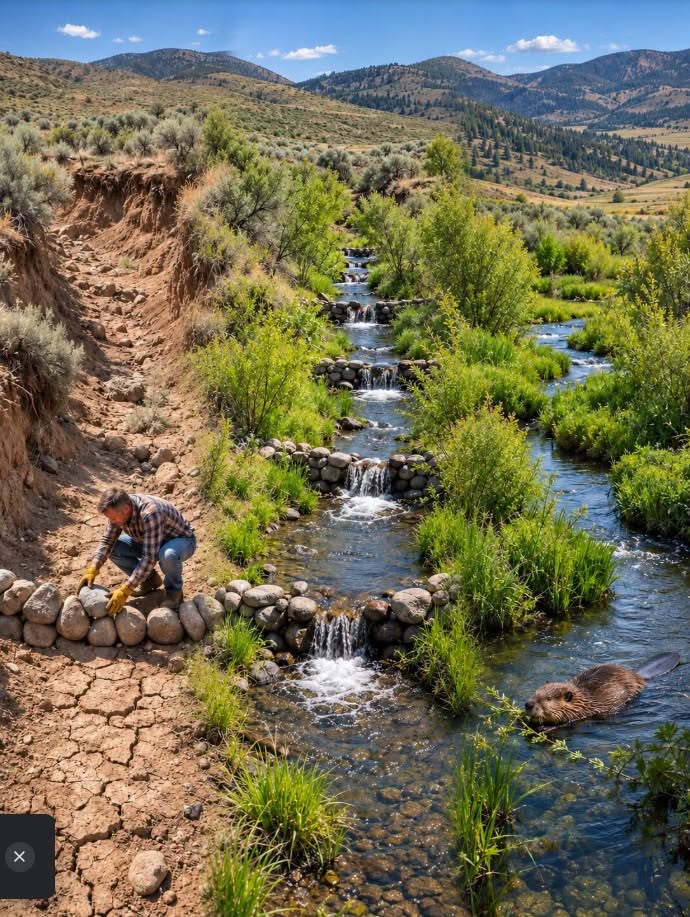
A rock pile slowed the current.
Slow water dropped sediment.
Sediment raised the bed.
A higher bed put water closer to the floodplain.
More water entered the surrounding soil.
Wetter soil supported vegetation.
Vegetation strengthened the banks.
Stronger banks reduced erosion.
Willows returned.
Willows gave beavers food and building material.
Beavers strengthened the structures.
Stronger structures held water longer.
The valley that had once pushed water away as quickly as possible began holding it again.
That difference could be felt most clearly in August.
On dry ground outside the restored area, the season still behaved like eastern Oregon.
Sagebrush stood gray against hard earth.
Summer heat pulled moisture from the surface.
Vegetation cured.
Fire remained part of the country.
Cross into the restored meadow and the ground told another story.
It softened.
Grass remained alive.
In places, a boot could sink into damp earth.
Water could still be heard moving beneath vegetation long after the seasonal flows once would have disappeared.
And in that water were trout.
Their return carried a meaning no argument in a government office could quite match.
Years earlier, officials had worried Campbell’s structures would obstruct those fish.
The concern had become part of the case against him.
Now the fish had found the creeks themselves.
Campbell had not stocked them.
They had followed connected water into habitat that had become usable again.
The river had become its own witness.
The satellites provided another.
From orbit, researchers could see summer vegetation staying greener after the structures were installed, even when precipitation did not increase enough to account for the change.
The wildfire provided another.
Flames that had raced through thousands of hectares of dry country reached the wet meadow and lost the fuel they needed to continue.
The beavers provided another.
When the creeks were deep dry trenches, transplanted beavers elsewhere had demonstrated the problem: an animal could not be ordered to restore habitat it could not survive in.
But once Campbell’s creeks held perennial water and supported willow, beavers came voluntarily.
That may have been the clearest sign of all.
The valley no longer needed to be persuaded to recover.
It had begun participating.
There is an easy version of Campbell’s story in which one stubborn rancher was right and every government official was wrong.
The actual story was more complicated.
Oregon had reasons for requiring permits.
Streams are connected systems. What one landowner does upstream can become another person’s flood, washed-out road, damaged field, or lost fish habitat downstream.
Campbell had not installed two or three harmless piles of stone.
He had undertaken work on an enormous scale.
The state had a legitimate responsibility to ask what those structures were doing.
But Campbell had also identified something regulations struggled to describe.
A damaged stream is not necessarily protected simply by being left untouched.
Sometimes doing nothing preserves the damage.
The channels on his ranch had spent generations becoming deeper.
Water had spent generations leaving faster.
The floodplain had become drier.
Vegetation had retreated.
Beavers could not return because the habitat required for their return had disappeared.
Waiting for the system to repair itself had not worked.
Campbell intervened.
He used local rock, gravel, and juniper.
He copied a principle rather than an exact structure.
Slow the water.
Let it leak.
Let it spread.
Repeat.
Then repeat again.
And again.
Until the creek no longer had a straight downhill run.
The method looked almost too primitive for the scale of the result.
No giant concrete dam towered over the ranch.
No enormous reservoir appeared behind steel gates.
The structures were low and rough.
Individually, many looked insignificant.
Collectively, they changed how water moved through an entire valley.
That was why the transformation could be difficult to understand at first glance.
Campbell had not created more rain.
He had changed time.
A gallon of water leaving the ranch immediately was almost useless to grass weeks later.
That same gallon stored underground and released slowly could still matter in August.
The total precipitation might be identical.
The landscape experienced it differently.
The old incised creek behaved like a gutter.
Campbell was trying to turn the valley back into a sponge.
The result rippled beyond his original goal.
He wanted better pasture.
He got longer-lasting water.
He wanted water available to cattle later in the summer.
He got wetter meadows.
The wet meadows resisted fire.
Vegetation returned.
The channel began filling.
Trout arrived.
Beavers followed.
And eventually the law followed too.
The legislation signed in 2021 did not erase Campbell’s fine.
It did not retroactively transform unpermitted work into permitted work.
He had paid the ten thousand dollars.
The dispute remained part of the history of the ranch.
But the legal landscape around him had changed almost as dramatically as the physical one.
A landowner working under the new eastern Oregon program, following its requirements, could now build the kind of low-tech structures for which Campbell had once been penalized.
The state would watch the results.
Photographs would accumulate.
Creeks would be monitored.
By 2027, Oregon expected its first major conclusions.
By 2032, the longer experiment was supposed to provide a fuller answer.
Campbell’s ranch, meanwhile, had already been running its own experiment for years.
There was an old line visible near Camp Creek that required no chart to understand.
Walk one direction and the ground remained dry and hard.
Sagebrush marked the country.
Walk toward the restored area and the earth changed beneath your boots.
The soil became softer.
Grass covered wetter ground.
Water remained where summer once erased it.
The difference had begun with piles of stone.
That was perhaps the strangest part.
Campbell had spent a career in veterinary medicine, building a business far from the creeks where he had grown up.
When he returned to eastern Oregon, he did not arrive with a revolutionary new machine.
He did not invent an elaborate technology.
He looked at what had once occupied those waterways and tried to imitate its function.
Beavers had slowed water with whatever the valley gave them.
Campbell did the same.
Then, once the valley became healthy enough, the beavers returned and took the work back.
There was a kind of symmetry in that.
People had removed the animals and watched the system unravel over generations.
A man eventually rebuilt enough of the missing structure for the animals to come home.
After that, they needed little instruction.
At night, when water whispered through a gap in one of Campbell’s old rock piles, a beaver heard the sound.
It moved toward it.
It carried sticks.
It pushed mud into openings.
It repaired the leak.
The pond rose by another fraction.
The soil beside the creek absorbed more water.
Willow roots reached into wetter earth.
Grass held its green a little longer.
The creek surrendered a little less of itself downstream.
No one had to issue an order.
No one had to draw a plan.
The animal simply worked.
Years earlier, Campbell’s workers had placed one structure every time the channel dropped about a foot.
Now those piles had become foundations for something alive.
The valley had gone from needing constant human intervention to recruiting its own engineers.
That was the real reversal.
The story had begun with a ranch full of channels so damaged that beavers would not stay.
Then a veterinarian began doing the beavers’ work.
The government fined him for doing too much of it without permission.
Scientists watched the landscape grow greener.
Fire stopped at the wet meadow.
Trout returned.
Lawmakers tried, failed, tried again, and eventually changed the rules.
And finally the beavers themselves came back.
By then Campbell no longer needed to prove that a creek could be made livable enough for them.
They were living there.
He no longer needed to argue that water could remain into summer.
It could be heard beneath the grass.
He no longer needed to imagine fish returning.
They were swimming through the channels.
The argument that had once existed in letters, permits, fines, and government offices had become something physical.
Stand at the edge of Camp Creek in August and the evidence was underfoot.
On one side, hard dry country.
On the other, soft ground holding water.
Years before, Campbell had been told that the structures crossing those channels required permits and could threaten the very ecosystem he said he was trying to restore.
Legally, the state had been entitled to enforce the rules that existed.
But nature was conducting a different kind of trial.
It measured results in water tables instead of paperwork.
In roots instead of regulations.
In fire that stopped where green grass began.
In beavers that chose to stay.
And in trout swimming through a creek where, within living memory, people had not expected to see them at all.
Scott Campbell had paid his fine.
The rocks stayed.
Then the water stayed.
Then the grass stayed green.
Then the beavers stayed.
See more on the next page
Advertisement