By the summer of 2014, the argument had become too large to stay inside the boundaries of Scott Campbell’s ranch.
State officials were looking at roughly a thousand structures laid across creeks in eastern Oregon. No permits had been issued for them. No applications had been filed. Some of the rock piles were small enough to step across. Others contained what amounted to dozens of dump-truck loads of stone.
To the agencies responsible for Oregon’s waterways, the problem was plain.
Work had been done in creeks without permission.
Worse, officials feared those structures could block redband trout from moving upstream and damage the vegetation along the banks.
Campbell saw the same valley and believed almost the opposite.
He saw water where there had once been dust.
He saw grass remaining green deeper into summer.
He saw battered channels beginning to heal.
And the strange part was that Campbell had never set out to become a river-restoration expert.
He had trained as a veterinarian.
Campbell had grown up around Burns, in eastern Oregon, in a family rooted in that country. His grandparents kept cattle. His father practiced medicine in an area where doctors were scarce. Campbell eventually left for the city and built a very different life.
In Portland, he bought a veterinary clinic.
One clinic became more. Over roughly twenty years, the business expanded until it had grown into a chain numbering in the hundreds. Eventually Campbell sold his share and returned to the country he had known as a boy.
He had learned how to build something at scale.
What waited for him in eastern Oregon, however, was not a business problem.
It was a landscape problem.
Campbell bought a run-down ranch between Burns and John Day. Across the property stretched about eighty-seven kilometers of creeks—or at least channels that maps and memory still called creeks.
Standing beside some of them, the word seemed generous.
They were deep cuts through the valley floor, in places deeper than a man was tall. For most of the year they were dry. Water rushed through during the wet season, then disappeared. By summer, the channels had become trenches separating one piece of thirsty ground from another.
The ranch received rain and snow. That had not stopped.
The problem was what happened afterward.
The water left.
To understand why, Campbell had to look backward, far beyond his own ranch and his own lifetime.
The valley had been stripped of several things that once worked together.
The first was beavers.
During the nineteenth-century fur trade, the Hudson’s Bay Company pursued an aggressive trapping strategy across the region south of the Columbia River. Beaver populations collapsed.
The missing animals left more than empty trapping grounds behind.
They left empty streams.
For thousands of years, beavers had been building low, imperfect barriers across those waterways. Their dams were nothing like concrete walls. Water seeped through sticks, mud, branches, and debris. It spilled around them. It spread outward.
But it slowed down.
That mattered.
A creek without obstacles could race downhill. Fast water carried sediment away and cut deeper into the earth. A creek broken by one beaver dam after another behaved differently. Water spread. Sand and gravel settled. Channels stayed broader and shallower. Spring flows could escape onto the surrounding floodplain.
Remove the dams, and the mechanics changed.
The water accelerated.
Instead of depositing sediment, it carried sediment away.
Year after year, the creek carved downward.
The valley remained where it had always been, but the stream sank beneath it.
Eventually water might be running six feet or more below the surrounding ground. Spring flows that had once spilled naturally over the banks were trapped inside steep-sided channels.
Scientists had a word for it: incision.
To a rancher, it looked like a ditch.
Then another piece disappeared.
Vegetation along the streambanks had taken decades of punishment from heavy grazing beginning in the nineteenth century. Willows and sedges were eaten back. Their roots had helped bind the soil together. Without enough of them, high water could tear at exposed banks.
Sections collapsed.
The channel widened in some places while continuing to deepen.
Then the landscape changed again.
For generations, fires that would once have moved through the country were suppressed. Western juniper expanded out of rocky areas and onto ground where younger trees had historically been kept in check.
The trees demanded water.
A mature juniper could consume an astonishing amount in a day.
The result was a valley receiving roughly the same gift from the sky that it had received long before Campbell arrived, but holding far less of it.
By July, the water was largely gone.
Campbell could have looked at those channels and accepted them as part of the ranch.
Instead, he began thinking about what was missing.
The obvious answer seemed to be beavers.
Bring the animals back, and perhaps they would rebuild what had vanished.
But experience elsewhere in Oregon had exposed a problem with that idea.
Researchers had released thirty-eight beavers into areas that appeared suitable on paper. The animals did not settle obediently into the damaged creeks and begin restoration work.
They scattered.
Within months, fewer than half were still alive, and only a handful had built dams.
The reason became painfully logical once the landscape was viewed from the beaver’s perspective.
A beaver needs a home before it can become an engineer.
It needs water deep enough to provide protection. It needs vegetation such as willow for food and building material. It needs a place where creating and maintaining a dam makes biological sense.
A dry trench with steep banks offered almost none of that.
Drop a beaver into such a place and the animal did not see a restoration project.
It saw bad habitat.
So it left.
That turned the usual idea upside down.
Maybe the damaged creek could not be repaired simply by bringing back the animal that once maintained it.
Maybe someone first had to make the creek livable enough for the animal to return.
Campbell decided to do part of the beaver’s work himself.
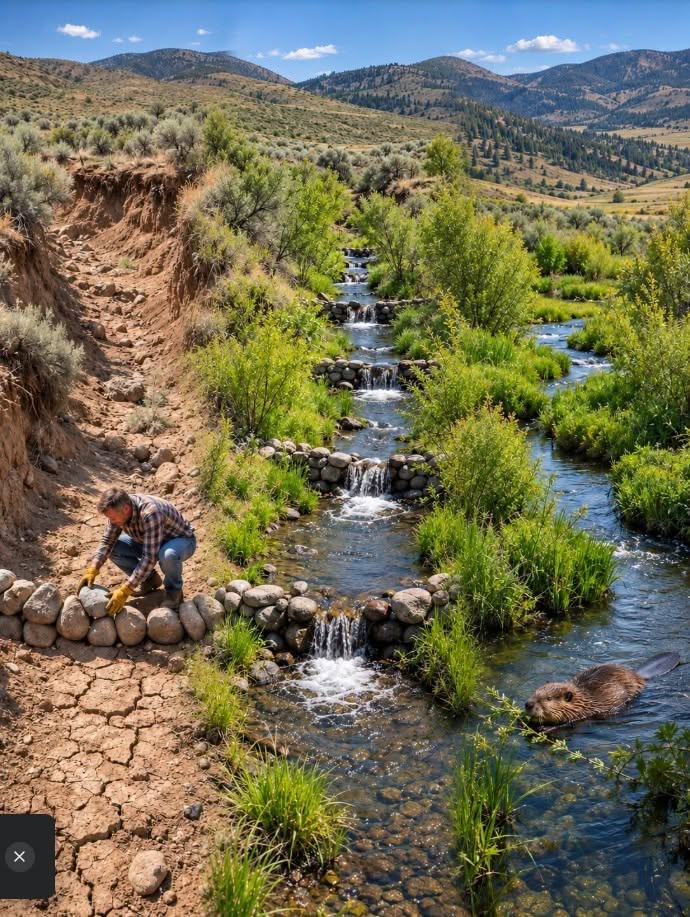
He was not trying to create giant reservoirs. He did not pour concrete across the valley. He was interested in something much simpler: putting rough obstacles back into the channels so water could no longer race through them unhindered.
Ranch workers gathered materials close at hand.
Rock.
Gravel.
Juniper logs.
They built low structures across the channels, placing them where a beaver might have placed a dam.
The idea was deliberately crude.
Water would hit the obstruction and slow down. It could pass through gaps between rocks. It could spill over the top when flows rose. But it would lose some of the energy that had allowed it to scour the creek bed deeper and deeper.
Campbell followed a simple rule.
Whenever the channel dropped roughly thirty centimeters in elevation, another structure should interrupt the flow.
On steeper sections, that meant more than sixty structures per kilometer.
There were no elaborate engineering drawings guiding each pile.
The work was done largely by eye.
One pile became another.
Then dozens.
Then hundreds.
Eventually, around a thousand low structures stretched along the ranch’s creeks.
And somewhere during that transformation, what Campbell considered practical ranch work crossed a legal line.
Oregon regulated work in waterways for good reason.
Move enough material in a creek and a permit was required. The threshold was not enormous—roughly the equivalent of several loaded dump trucks of material.
Campbell had moved far more than that.
One of his largest structures alone contained around eighty dump-truck loads.
Across the ranch, the total was immense.
And Campbell had not obtained a permit for any of it.
The law was not written merely to irritate landowners.
Structures built in streams could cause real damage.
A poorly placed obstruction could back water into a neighbor’s field. It could contribute to washed-out roads or blocked culverts. It could turn usable ground into mud. It could redirect water somewhere no one expected it to go.
And then there were fish.
For state officials, that concern carried particular weight.
A barrier across a stream could interfere with migration to upstream spawning habitat.
Natural beaver dams had existed alongside fish for thousands of years, but Campbell was not a beaver.
He was a landowner deliberately moving rock and wood inside channels.
By the summer of 2014, the issue had reached the governor’s office.
The governor’s natural-resources adviser described the scale of the work: approximately a thousand dams or dam-like structures, constructed without permits.
Officials believed the work could be harming streamside vegetation and interfering with redband trout.
From the state’s point of view, Campbell had done precisely what waterway regulations existed to prevent: he had changed creeks on a massive scale first and asked permission never.
From Campbell’s point of view, the state had arrived after the valley had already begun responding.
And there was another contradiction buried beneath the dispute.
When Campbell had begun working on some of those channels, they were nearly dry gullies.
A dry channel crossing private land did not necessarily carry the same legal status as a living, fish-bearing stream.
But Campbell’s structures slowed water.
The slower water soaked into gravel.
The groundwater rose.
Flow lasted longer.
By the time inspectors came, some places no longer looked like the dry channels Campbell had started with.
There was water.
And with the water came regulation.
In the strangest interpretation of the entire dispute, Campbell had helped create the conditions that made his work subject to greater scrutiny.
He had made the creek healthy enough to become legally troublesome.
The conflict ended not with bulldozers tearing out all the structures, but with an agreement.
Campbell would submit a plan addressing potential damage.
He would pay ten thousand dollars into Oregon’s state school fund.
The rock structures could remain.
Legally, the state had made its point.
Campbell had worked in regulated waterways without obtaining the required authorization.
But another question remained.
Had the work itself actually hurt the valley?
Or had a man just been fined while the land beneath his boots was quietly proving him right?
The answer would not come from Campbell.
It would not come from the officials who had challenged him, either.
The most impartial witness had been watching from hundreds of miles overhead.
And it had been watching for decades.
Part 2
Long before Campbell began stacking rock across the creeks, satellites had been photographing eastern Oregon.
Landsat imagery provided researchers with something arguments rarely could: a record of the landscape that did not care who owned the ranch or who had signed the violation notice.
Year after year, the satellites had recorded the valley.
Researchers examined more than three decades of imagery and focused on four creeks associated with Campbell’s work.
They compared two basic things.
How much precipitation had fallen?
And how green was the valley during the hottest part of summer?
Before the restoration work, the relationship was brutally predictable.
Wet years produced greener ground.
Dry years produced browner ground.
That made sense. The landscape had little capacity to hold water. What arrived during the wet season moved through quickly, leaving summer vegetation dependent on whatever the sky had recently provided.
After Campbell’s structures went in, that relationship changed.
The valley remained greener even during dry years.
The same pattern appeared across all four creeks studied.
The rain had not increased enough to explain the difference.
The water was simply staying longer.
The rock piles were doing something that could be easy to misunderstand if they were imagined as miniature versions of conventional dams.
They were not walls.
They were more like rough sieves.
Water struck them, slowed, and passed through.
That loss of speed changed where the water went.
Instead of racing down the channel, more of it had time to soak into the porous ground surrounding the creek.
A small pond might appear upstream of a structure, but the visible pond was only part of what mattered.
The larger reservoir was underground.
Water entered gravel and soil across the valley floor.
The water table rose.
The landscape began behaving less like a gutter and more like a sponge.
A gutter gets rid of rain efficiently. Water lands, runs, and disappears.
A sponge does the opposite.
It absorbs.
It holds.
Then it releases slowly.
For decades, the incised channels had turned the valley into something close to a drainage system. Water rushed through the bottom of the ditch while the surrounding ground remained high and dry.
Campbell’s structures interfered with that efficiency.
In doing so, they made the valley wetter.
Water that once disappeared downstream within days could remain underground for weeks, gradually finding its way back toward the creek.
That changed the calendar of the ranch.
Summer no longer meant the same thing.
Grass stayed green longer.
See more on the next page