

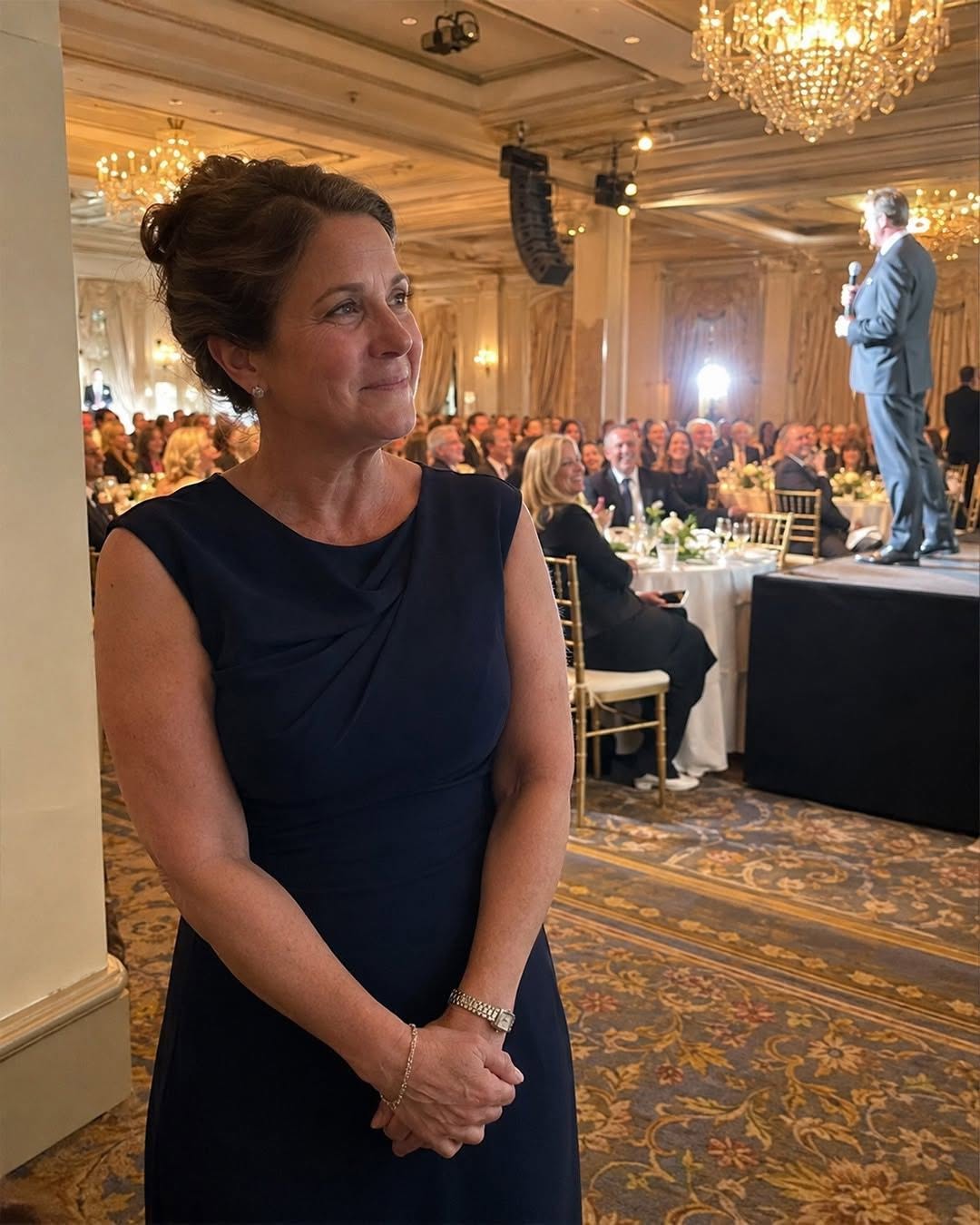
Then he walked away, leaving the ballroom full of whispered recalculations.
The rest of the evening continued, because expensive events always continue. Coffee was served. Donors signed pledge cards. Guests smiled too brightly and pretended they had not enjoyed the cruelty quite as much as they had.
Thomas closed the program quickly. Fewer jokes. Shorter pauses. His voice remained smooth, but something in him had gone watchful.
When the crowd thinned near the bar, he found me.
“That was unusual,” he said.
“Yes.”
“Do you know him?”
“No.”
“He must know you somehow.”
“Apparently.”
Thomas studied my face. “Whatever it is, it’s good for the foundation. A million-dollar bid makes headlines.”
“I don’t think he did it for headlines.”
“No one spends that kind of money without a reason.”
“I agree.”
He leaned closer, lowering his voice.
“Be careful, Laura. Men like that don’t move without purpose.”
The irony was so clean I nearly smiled.
“Neither do you,” I said.
He looked at me, unsure whether I had meant anything by it.
I had.
I left before the after-gathering upstairs. Outside, the October air was cool enough to clear the smell of perfume and wine from my throat. The city moved around me with its usual indifference: cabs rolling past, a doorman lifting a hand, someone laughing into a phone half a block away.
In the dark glass of the hotel entrance, I saw my reflection.
Same navy dress.
Same pinned hair.
Same calm face.
But something had shifted.
Not because a stranger had placed a price on dinner with me.
Because for one bright, uncomfortable moment, a room that had laughed at my humiliation had been forced to reconsider what, exactly, it had been laughing at.
My phone vibrated before the car reached home.
Mrs. Bennett, Mr. Hail asked me to confirm dinner tomorrow at 7 p.m. Restaurant details attached. He looks forward to speaking with you.
No flourish. No explanation.
At home, I took off my heels in the kitchen and poured a glass of water. The townhouse was quiet. Thomas would be late. He was always late after events, especially events that required damage control.
I sat at the kitchen table and thought about the word useless.
It had not hurt the way it would have years earlier.
At thirty, humiliation burns.
At fifty, it settles.
It becomes a stone you carry in your pocket. Heavy, private, familiar.
And sometimes, unexpectedly, someone else notices the weight.
The next evening, Edward Hail chose a restaurant with no sign outside, only a narrow brass number beside a glass door between a bookstore and a tailor shop on Madison Avenue.
I arrived five minutes early.
He was already seated.
He stood when I approached, not with performance, but with an old-fashioned courtesy that seemed less about manners than attention.
“Mrs. Bennett,” he said.
“Mr. Hail.”
“Edward, if you’re comfortable.”
“Laura, then.”
We sat across from each other at a corner table beneath low amber light. The room was quiet enough for private conversation but not so quiet that silence felt exposed.
After the waiter left with our order, Edward folded his hands.
“I owe you an explanation.”
“You paid a million dollars for one. I assumed it was coming.”
He smiled faintly.
“I’ve been looking for you for several years.”
That was not what I expected.
“I’m not difficult to find.”
“You are if a person only has a first name, an old neighborhood, and a story told by a dying woman.”
The air seemed to still between us.
“Who was she?” I asked.
“My mother. Margaret Collins.”
The name came first as sound. Then feeling. Then memory.
Rain on a gray sidewalk.
A paper grocery bag split open near the curb.
Apples rolling into the street.
A woman in a worn beige coat kneeling too quickly, apologizing to strangers who were not helping.
I saw myself at twenty-five, newly married, carrying an umbrella I had bought from a drugstore because the forecast had lied.
“She dropped her groceries,” I said softly.
Edward nodded.
“You helped her pick them up.”
“She was crying.”
“She told you she was fine.”
“She wasn’t.”
“No,” he said. “She had been evicted that morning.”
The memory returned more fully now. Margaret’s trembling hands. The coffee shop on 73rd Street with fogged windows and vinyl booths. Her insisting she did not want to impose, while every word out of her mouth revealed she had nowhere to sleep.
“I bought her coffee,” I said.
“You stayed two hours.”
“I don’t remember that.”
“She did.”
I looked down at the white tablecloth.
“She called me a few days later.”
“Two days,” Edward said. “You told her she could stay with you for a week.”
“She stayed three months.”
“You never made her feel like a burden.”
I swallowed.
I remembered Margaret in our guest room, folding towels she had not used. Making soup because she wanted to contribute. Leaving little notes by the coffee maker. I remembered telling her one morning, as she apologized for the fifth time before breakfast, “You don’t have to disappear to deserve help.”
I had said it without thinking.
Apparently she had remembered it longer than I had.
“She found work through one of your friends,” Edward continued. “A bookkeeping job.”
“Yes. A small office downtown.”
“She stayed there three years. Then she started taking private clients. Then she opened a bookkeeping service of her own.”
“I lost touch after she moved out,” I said. “I always wondered whether she was all right.”
“She was more than all right,” Edward said. “She built a company. Quietly. Carefully. No investors. No speeches. She sold it fifteen years later for enough money to change our family.”
A waiter arrived with our drinks. We paused while he set them down.
Edward waited until he left.
“My mother died two years ago. Before she did, she asked me to find you.”
“I’m sorry,” I said.
“Thank you.”
His voice remained steady, but grief sat beneath it, disciplined and unmistakable.
“She said you gave her something more important than money. You gave her time. One safe room. One month without panic. She said that was the difference between falling and rebuilding.”
“I had a spare room,” I said, because anything larger felt impossible to accept.
Edward shook his head.
“No. You had a choice. You made it.”
We ate slowly, though I barely tasted the food. Edward told me about Margaret’s later years, how she kept grocery receipts from those first months because she intended to repay what she could, how she volunteered at a tenants’ clinic after retirement, how she never passed a woman crying on a sidewalk without stopping.
Then he reached into his jacket and placed a cream envelope on the table.
“She wrote this for you.”
I touched it but did not open it.
“She wanted you to read it before I explained the rest.”
“The rest?”
“Yes.”
There was no drama in the word. That made it heavier.
I slid the envelope into my bag.
“I’d like to read it at home.”
“Of course.”
When we stood outside after dinner, the city had turned sharp with evening chill. Edward walked me to the curb but did not crowd me.
“My mother used to say quiet kindness is still a kind of architecture,” he said. “Most people only notice buildings when they’re finished.”
I looked at him.
“She became the sort of person who spoke that way?”
“She became the sort of person you helped her remember she could be.”
The car arrived.
As I rode home, Margaret’s letter rested in my lap.
Twenty-five years earlier, I had opened a guest room door for a woman with wet shoes and shaking hands.
Now her son had opened a door in front of two hundred people, and I had the strange feeling that neither act had been as small as it seemed.
I read the letter at my kitchen table.
Thomas was still out, his calendar full of meetings that sounded more urgent than they ever were.
The house was quiet except for the hum of the refrigerator and the faint hiss of the radiator near the windows.
Margaret’s handwriting was careful, slightly slanted, each line spaced as though she wanted the words to breathe.
Laura,
You once told me kindness doesn’t need witnesses. I disagreed then, and I disagree now.
Kindness deserves to echo, even if quietly.
You gave me a room, but what you really gave me was time. Time to sleep without being afraid. Time to answer a phone call with a steady voice. Time to become useful to myself again.
You never asked me to perform gratitude. You never made me explain my pain twice. You let me sit at your kitchen table as if I belonged there until I remembered that I did belong somewhere.
If I have done anything good with my life, some part of it began in your spare room.
I had to stop reading.
The kitchen blurred slightly, not from shock, but from recognition. Margaret had described something I had not fully understood at the time: the dignity of not making rescue feel like a debt.
I kept reading.
I set something aside for you. Not because kindness is a transaction. It is not. But because I wanted one good thing to return to the woman who never looked around for applause.
Edward will explain.
Please let him.
And if you do accept what I arranged, use it in whatever way feels like you. Quietly, probably. Steadily, certainly.
With gratitude beyond words,
Margaret
I folded the letter with both hands.
No dramatic number. No grand announcement. Just intention.
Thomas came home shortly after midnight. I heard the door close, then his shoes on the floor.
He found me still at the table.
“You’re awake.”
Continued on next page:
To see the full cooking instructions, go to the next page or click the Open button (>) and don't forget to SHARE it with your friends on Facebook.