

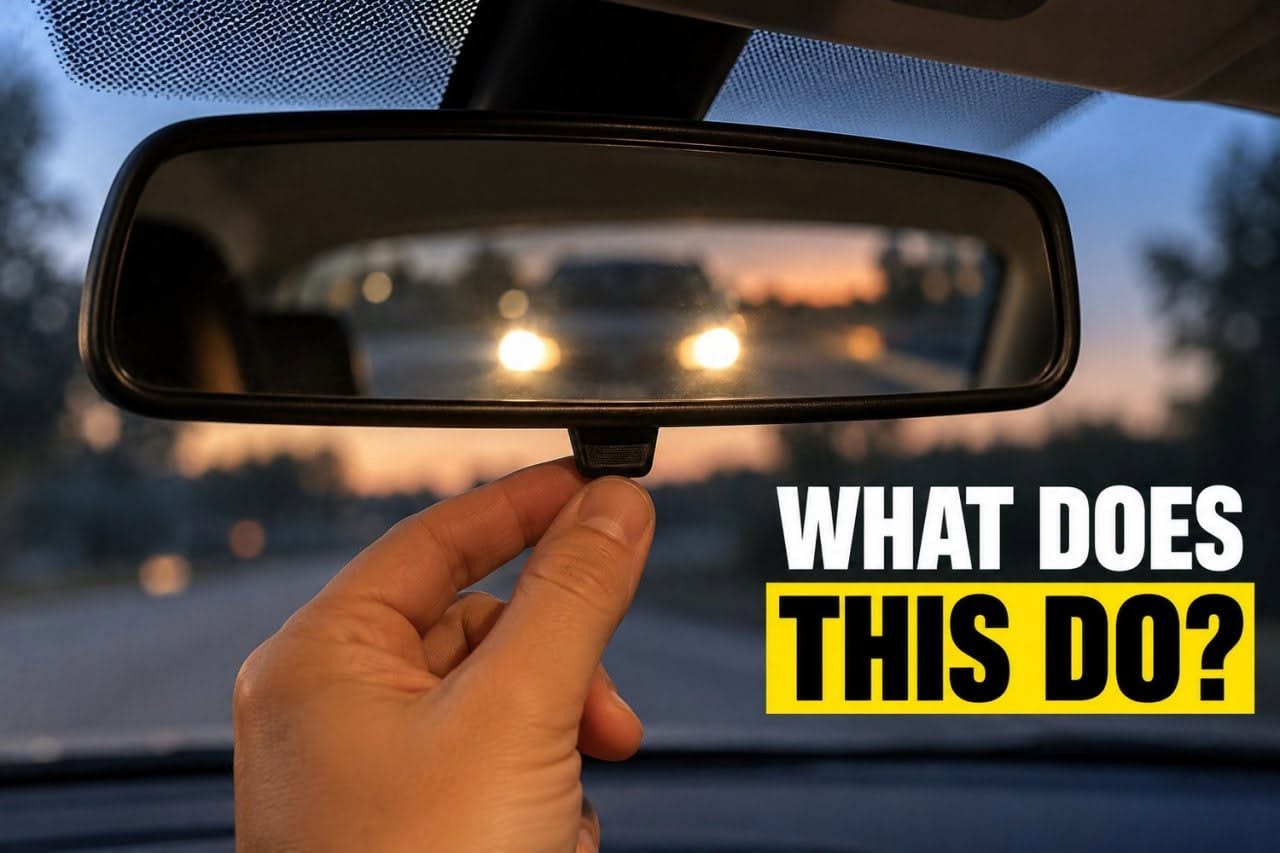
If your car has a traditional manual rearview mirror, you may have noticed a small tab or lever sticking out from the bottom. Many drivers see it every day without ever using it, while others may have moved it accidentally and wondered why the reflection suddenly changed.
That little piece isn’t decorative. On many manual rearview mirrors, it operates a simple day/night function designed to reduce the glare you see from headlights behind you while driving after dark.
It’s an old, remarkably simple piece of automotive engineering—and understanding how it works can make nighttime driving more comfortable.
What Is the Tab Under the Rearview Mirror?
The small lever is commonly found on manual day/night rearview mirrors. Moving it changes the angle of the mirror assembly so that the driver sees a much dimmer reflection instead of the normal bright one.
During the day, you generally want the mirror in its normal position because it provides a clear view through the rear window.
At night, however, bright headlights from a vehicle behind you can create uncomfortable glare in the mirror. That’s when the second position becomes useful.
What Happens When You Move the Tab?
Try it while the vehicle is safely parked and you’ll notice something interesting.
Moving the tab doesn’t simply cover the mirror with darker material. Instead, the mirror changes position slightly and presents a dimmer secondary reflection to your eyes.
The headlights behind you become much less intense, but you can still see enough of the scene behind the vehicle to use the mirror.
Move the lever back and the normal brighter reflection returns.
How Can a Simple Lever Make the Reflection Darker?
A traditional manual day/night mirror uses clever optical design rather than electronics.
The mirror assembly can provide two different reflections. The strong reflection is the one you normally use during daylight. A much weaker reflection can come from the front surface of the mirror glass.
When the lever changes the mirror’s angle, the strong reflection is directed away from your eyes while the weaker reflection becomes the one you see.
That’s why headlights suddenly appear much dimmer even though the glass itself hasn’t magically become tinted.
And there is another detail many drivers don’t realize: not every modern car uses this little lever anymore.
Why Is This Feature Useful at Night?
Imagine driving along a dark road while another vehicle follows behind you with bright headlights.
Your eyes have adjusted to the darker environment, so a strong reflection from the rearview mirror can be distracting and uncomfortable. Using the night position reduces the intensity of that reflected light.
The goal isn’t to eliminate your view behind the vehicle. Instead, the design gives you a dimmer version of that view so bright lights are less bothersome.
When Should You Use the Night Position?
The feature is most useful when headlights from vehicles behind you are producing noticeable glare in your interior mirror.
You don’t necessarily need to switch it every time you drive after sunset. If there is little traffic behind you or glare isn’t a problem, the normal position may provide the clearest view.
If glare becomes uncomfortable, however, moving the lever can quickly reduce it.
Should You Move It Back During the Day?
Yes. The normal daytime position generally provides a brighter and clearer rearward view.
The night position intentionally makes the reflection much dimmer, so leaving a manual mirror in that position during daylight can make the rear view unnecessarily difficult to see.
If your rearview mirror suddenly seems unusually dark during the daytime, check whether the lever was accidentally moved.
Why Doesn’t My Car Have This Tab?
If you’ve looked under your rearview mirror and can’t find a lever, nothing is necessarily missing.
Many newer vehicles use an automatic dimming rearview mirror instead.
These mirrors can use sensors and electronic technology to detect lighting conditions and reduce reflected glare automatically. The exact system varies by vehicle.
Some auto-dimming mirrors also include buttons, indicators or other controls, while others work largely without driver input.
Manual vs. Auto-Dimming Mirrors
The basic objective is similar: reduce uncomfortable glare from lights behind the vehicle.
A manual day/night mirror accomplishes this mechanically. You move the small lever yourself and the mirror changes the reflection reaching your eyes.
An auto-dimming mirror uses an electronically controlled layer that can darken when the system detects conditions associated with glare.
The automatic version is more convenient, but the traditional mechanical design has one major advantage: it is extremely simple.
Does Moving the Tab Move the Whole Mirror?
It may feel as though you’re simply tilting the mirror, but the mechanism is designed so that switching between positions changes which reflection reaches your eyes while maintaining a useful rearward view.
This is also why the mirror should first be adjusted correctly for your normal driving position.
The little lever isn’t intended to replace proper mirror adjustment.
Adjust Your Rearview Mirror Before Driving
Before driving, adjust the interior mirror so you have an appropriate view through the rear window while sitting in your normal driving position.
Make adjustments while the vehicle is stationary rather than trying to reposition the mirror while concentrating on traffic.
If your vehicle has an unusual mirror system or electronic controls, consult the owner’s manual for the manufacturer’s instructions.
What If Moving the Tab Doesn’t Seem to Do Anything?
There are several possibilities.
First, the difference can be much easier to notice at night when bright lights are visible behind the vehicle. In daylight, the effect may not be immediately obvious.
Second, your vehicle may use a different mirror design. And if the lever is loose, damaged or doesn’t remain in position, the mirror may need to be inspected.
Avoid forcing a control that doesn’t move normally.
Once you start noticing details like this, you’ll find that cars contain several small features hiding in plain sight.
Other Small Car Features Drivers Often Overlook
The rearview mirror lever isn’t the only everyday vehicle detail whose purpose isn’t immediately obvious.
Many cars include small design features that drivers may use for years without fully understanding them.
The Arrow Beside the Fuel Pump Symbol
Look at the fuel gauge on many vehicles and you may see a tiny arrow or triangle next to the fuel-pump icon.
On vehicles equipped with this indicator, the arrow points toward the side of the vehicle where the fuel filler is located.
It’s particularly convenient when you’re driving a rental car or a vehicle you don’t use regularly and need to know which side of the gas pump to approach.
The Black Dots Around the Windshield
Those small black dots around the edge of many windshields aren’t simply decorative.
They are part of the ceramic frit pattern used around automotive glass. The black border is associated with the windshield bonding area and helps shield it from ultraviolet light, while the dotted pattern creates a gradual transition between the dark border and clear glass and also plays a role in manufacturing considerations.
The Rear-Door Child Safety Lock
Many vehicles have a small switch or slot on the edge of each rear door.
When the child safety lock is engaged, the rear door generally cannot be opened using its inside handle, although it can still be opened from outside when the vehicle is unlocked.
The exact mechanism varies, so the owner’s manual is the best reference for your particular vehicle.
Hidden Mechanical Key Inside Some Key Fobs
Some modern key fobs contain a small removable mechanical key.
It can provide a backup method of accessing the vehicle in certain situations, such as when the key-fob battery is depleted. The location of the physical lock cylinder and the correct procedure differ significantly between vehicles, so owners should check their manuals before they actually need the feature.
Why Small Features Like These Are Easy to Miss
Most people don’t read every page of their vehicle’s owner’s manual when they buy a car.
Instead, we learn the controls necessary for everyday driving and gradually discover the rest.
That’s why something as simple as a rearview-mirror tab can remain a mystery for years. It doesn’t call attention to itself, and unless glare becomes annoying at night, there may never be an obvious reason to move it.
One Important Difference to Remember
Cars vary widely by manufacturer, model and year.
If your mirror has electronics, cameras, sensors or unfamiliar buttons, don’t assume it works exactly like a traditional manual day/night mirror.
Some vehicles integrate the mirror with driver-assistance systems, displays, cameras or other electronics. Always follow the instructions provided for your specific vehicle.
A Simple Feature That’s Been Hiding in Plain Sight
So, what does that little tab under a traditional rearview mirror do?
It lets you switch a manual day/night mirror between its normal bright reflection and a much dimmer reflection that can reduce glare from headlights behind you at night.
There are no batteries required and no complicated electronics involved. It’s simply a clever use of reflection and mirror geometry controlled by one tiny lever.
It’s the kind of feature you might ignore for years—until one nighttime drive makes you glad you know exactly what it does.